How to Choose the Best Wine Bottle Gift Boxes?
Choosing the right Wine Bottle Gift Boxes means balancing protection, presentation, and practical use. A box should keep the bottle steady, cushion its shoulders, and prevent the glass from knocking against hard surfaces. Protection comes first. Yet the unboxing matters too. A neatly fitted insert, smooth edges, and a secure lid can make a simple bottle feel considered rather than overwrapped.
Packaging pioneer Walter Landor is widely credited with saying, “Products are made in the factory, but brands are created in the mind.” His observation concerns branding broadly, not wine gift boxes specifically, but it offers a useful lens: packaging shapes how a gift is perceived. For wine, materials such as sturdy paperboard, textured finishes, or fitted wood can signal different occasions. The best choice depends on the bottle’s weight, the recipient, and how far it must travel. A glossy finish may look elegant under store lights, but fingerprints can show. Small trade-offs count.
This guide will compare box styles, materials, closures, inserts, and customization options. It will also consider cost, storage, and shipping needs, so appearance does not overshadow function. Think about the moment the recipient opens the box—and what happens before it gets there. No single design suits every bottle or budget. A beautiful box that lets the bottle shift is not a good choice. A practical one can still feel personal, with a carefully chosen color, message, or ribbon.
Define Bottle Fit Around the Standard 750 mL Wine Format
A 750 mL fill does not guarantee a universal bottle shape. Standard still-wine bottles often measure about 300 mm tall and 75–85 mm wide, but shoulders, punt depth, and glass thickness vary. Measure the actual bottle before choosing a gift box. Leave a little clearance so the glass slides in without scraping, while inserts keep it from shifting.
The scale of the category is substantial: the International Organisation of Vine and Wine estimated 2023 global production at 237 million hectolitres, its lowest level since 1961 (State of the World Vine and Wine Sector in 2023, 2024). That figure is not a packaging specification. It does show why a box designed around one “standard” bottle can miss real-world variation across producers and bottle styles. Check height, body diameter, and neck position, then test the fit with the bottle upright and the lid closed. A snug fit matters. Oversized cavities can let the bottle knock against the box during handling. One detail is easy to overlook: thick protective sleeves change the fit, too. Measure with the sleeve on if it will be included.
How to Choose the Best Wine Bottle Gift Boxes?
Define Bottle Fit Around the Standard 750 mL Wine Format
These are typical approximate exterior dimensions; bottles vary by producer. Check the actual bottle’s height and widest point before choosing a box, and allow room for protective packaging.
Compare Box Strength Using ECT and Burst-Test Ratings
When choosing wine bottle gift boxes, compare the board’s ECT and burst ratings, not just its thickness. The Fibre Box Association’s corrugated packaging guidance describes ECT as a measure of edgewise stacking strength. Burst strength measures resistance to pressure that can rupture the board. They test different stresses. A high score in one does not guarantee strong performance in the other.
For context, industry conversion charts commonly pair 32 ECT board with a 200-pound-per-square-inch burst rating. Treat that as a rough comparison, not a guarantee: board construction and test conditions matter. TAPPI test methods T 811 and T 810 specify procedures for measuring edgewise compression and bursting strength. Ask suppliers which test method and units their ratings use. Numbers without methods can mislead.
Picture six bottles in a gift box, with dividers and a handle cutout. Those details can weaken panels or concentrate loads, even when the outer board has a solid ECT rating. Check how the filled box performs when stacked and carried. If it will travel through parcel delivery, test a packed sample under realistic handling. I’d avoid choosing by burst rating alone; it sounds reassuring, but it may miss the box’s main failure point. A little testing helps.
Validate Shipping Protection with ISTA 3A Drop Tests
Choosing a wine gift box means testing the complete packed unit, not just admiring its finish. ISTA 3A evaluates individual packages moving through parcel-delivery systems, including drops and vibration. A wine bottle can strike the base, push against a divider, or loosen its neck support during handling. The box should keep glass from contacting other bottles and cushioning from compressing flat. No test predicts every rough handoff. That matters.
The 2024 Parcel Shipping Index reports about 161 billion parcels worldwide in 2023, a reminder that gift boxes face repeated handling across busy networks.
Use ISTA 3A drop testing to check realistic shipping configurations, with the actual bottle, inserts, closure, and outer carton. Inspect for cracks, chipped rims, displaced dividers, and damp or scuffed presentation surfaces after testing. Record the package weight and test conditions so results can be repeated. A single successful drop is not enough; repeated impacts can expose weak corners or a loose fit.
Tips: Leave snug clearance around the bottle, support its base and neck, and avoid relying on decorative tissue as cushioning. Test the heaviest bottle-and-box combination. If the box survives but the presentation looks battered, protection still needs work.
Check Materials Against EU 2030 Packaging Recyclability Rules
A wine gift box should protect the bottle, feel thoughtful, and suit the occasion. But the outer package deserves a closer check. EU packaging rules are moving toward stricter recyclability requirements, with design-for-recycling criteria expected to apply from 2030. Exact duties depend on packaging type and implementation details, so an “eco-friendly” label is not enough evidence. Ask the supplier for material specifications and recyclability documentation.
Uncoated paperboard is often easier to sort than laminated board. Still, coatings, plastic windows, foil, magnets, foam, and mixed-material inserts can complicate recycling. A glossy finish may look premium. It may also signal a layer that needs checking. For a single-bottle gift, molded paper-pulp supports or a fitted cardboard divider may reduce plastic components. Check adhesives and decorative ribbons too.
Ask whether each component can be separated by hand, and whether local collection systems accept it. Request the box’s packaging category, material breakdown, and test basis—not just a broad claim of recyclability. EU requirements will develop through technical criteria; confirm current guidance before ordering large quantities. A small sample can be useful, but it may not reveal every layer. That uncertainty matters.
Match Inserts and Finishes to Bottle Count and Gift Use
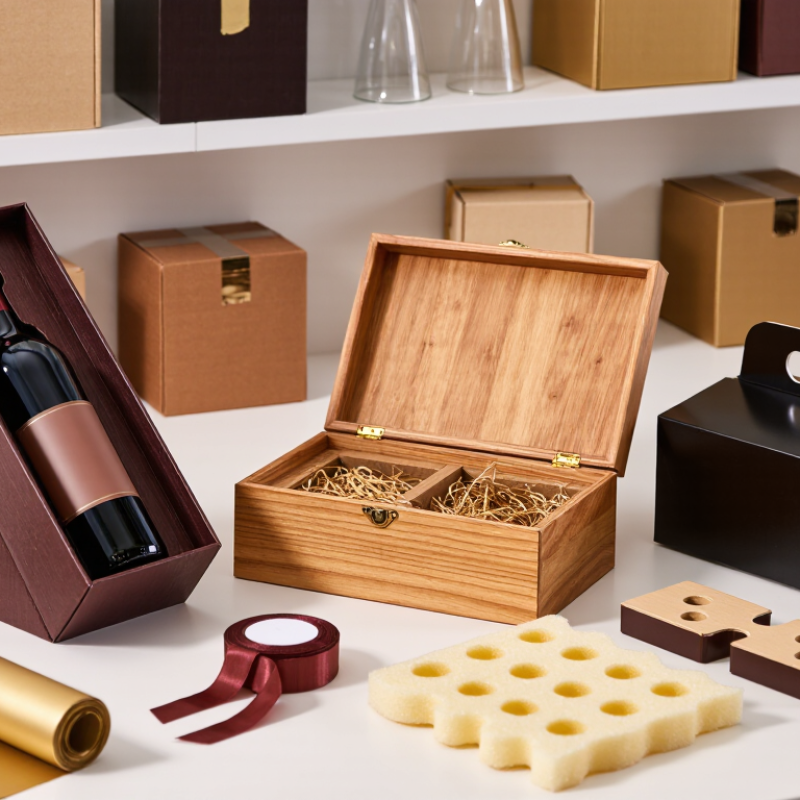
The right wine gift box starts with the bottle count and the journey it will make. A single bottle usually suits a snug, shaped insert that keeps the glass from shifting. For two or three bottles, use separate compartments with firm dividers. Check that the necks cannot knock together when the box is gently tilted. A pretty insert is not enough if it leaves a bottle loose. Test the actual bottle size, too; shapes and shoulder widths vary more than many buyers expect.
Match the finish to the occasion and handling. A matte paper wrap feels understated and hides small scuffs, while a smooth coated surface is easy to wipe clean. For a formal gift, a restrained foil detail can add polish without making the whole package look busy. Keep in mind that textured finishes may catch on sleeves or show wear during delivery. The choice is not always obvious. A box displayed at a dinner may need less cushioning than one sent through several handling points, but appearance should never replace a secure fit. If possible, pack a sample and check the lid, insert, and bottle together before ordering a full run. This step can feel fussy. It often prevents an expensive mismatch.